
Materiality's 3 Body Problem
This article is the fourth in a series exploring the role of trustworthy AI in mainstreaming sustainable investing.
Say GHG emissions is the most material sustainability topic for a company, but it's Access & Affordability for the company's peer group, and Business Ethics for the business's benchmark. What is the answer to the deceptively simple question: "What is the most material sustainability topic for the company?"
Materiality assessments - both single and double, ISSB and ESRS - have a 3 body problem. When preparing an assessment, the guidance is clear: compare the entity in question to a peer group and a benchmark to give context. This is correct and sensible. But it's remarkably hard to do objectively, in a data-driven methodology, with an auditable process.
A chaotic, unpredictable system
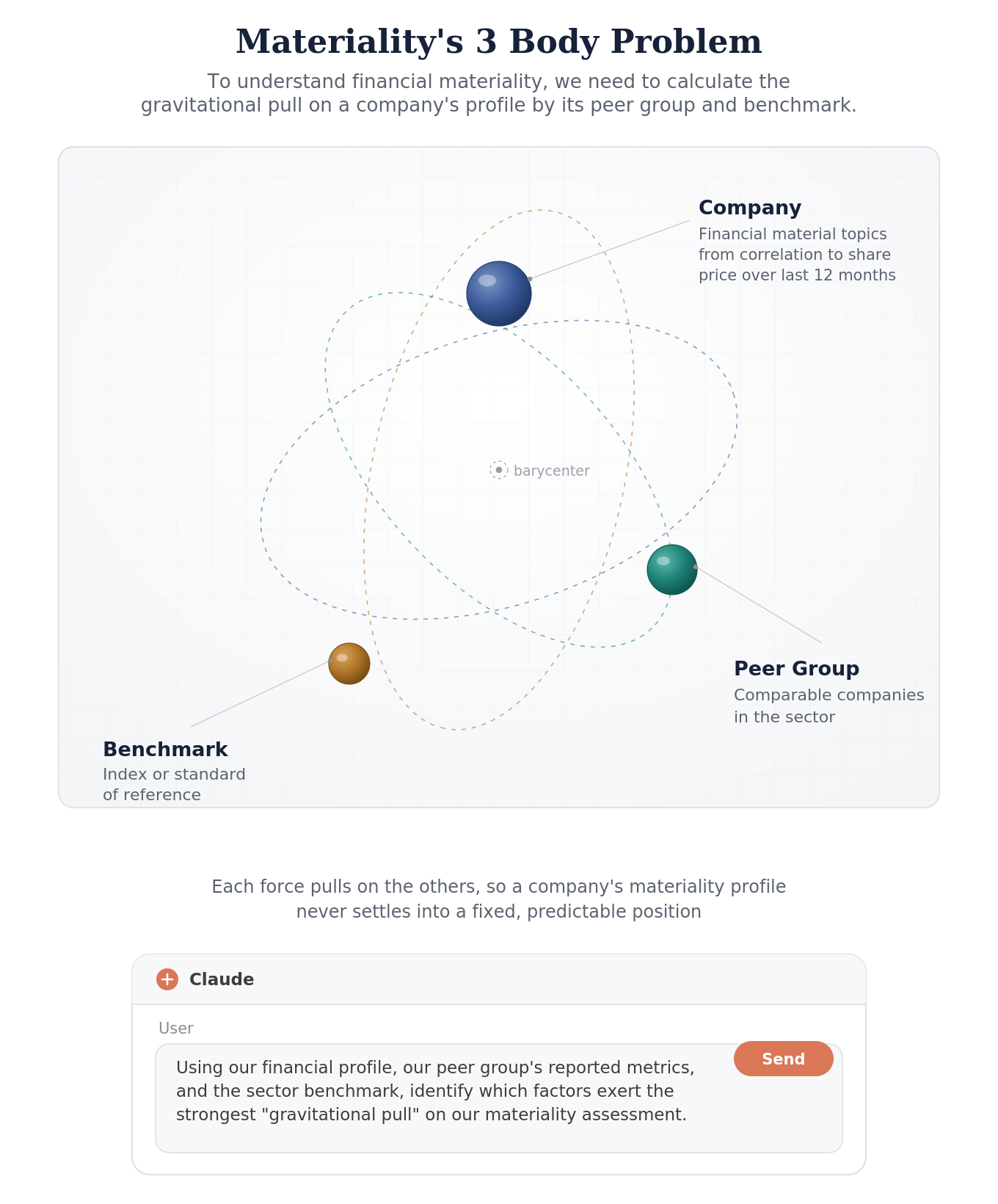
The reason is well-known in classical mechanics or astrophysics. It is called "The 3 body problem". It is the mathematical study of how three celestial objects (like stars or planets) interact purely through their gravitational pull. While a "two-body" system (like the Earth and Sun) has predictable orbits, adding a third body (like Earth's moon) creates a chaotic, unpredictable system with no general mathematical formula to solve it.
In our terms, the reporting company is the Earth, the peer group is Moon and the benchmark is the Sun. Using publicly-available data from traditional, trade and social media correlated to closing day share price, we can build a materiality profile of a company (Earth), aggregate several peer companies to build a peer group's profile (Moon), and aggregate all the companies in a benchmark to build a benchmark's profile (Sun). The three profiles act on each other in a chaotic, unpredictable way. To be clear, we have a reasonable answer one, two, three month into the future but, beyond that, there is no way to predict the where the Earth will be. So we struggle to answer the question: "What is the most material sustainability topic for the company?"
Bringing order to chaos
To pick a current example, SpaceX was given a triple C assessment by MSCI ahead of its IPO. This is based on its terrible Governance factors. By contrast, the most material topics for SpaceX's peer group are predominantly focused on Social factors, for example the social media ban for under 16 years olds announced in the UK, following the example of Australia. And SpaceX's benchmark, the S&P 500, has a number of Environment factors as material.
So how can we calculated the most material factors for SpaceX if there is such a wide divergence between company, peer group and benchmark? It's not a question of 'which one is right' but instead 'which factors are likely to become material for the company in the context of its peers and benchmark?'
Mind the gap
Using open sourced intelligence correlated to share price, we can now generate quantitative scoring for all the entities involved. Until now, this has been impractical and inefficient due to the amount of expert time that would have been required. Even then, the results would have been out-of-date and certainly non-predictive by the time of publication.
Working with Brunel University of London, we have deployed a mathematical model called a Schur norm. This calculates the distances between matrices of numbers (in this case, a financial materiality profile) for company, peer group and benchmark. By measuring how far apart the profiles are, we can calculate whether the company is an outlier or not. With a weekly time series, we can calculate the directionality and velocity of the profiles from each other. This can be reported in a simple visual manner, and queried using standard conversational AI tools like Claude.
For example:
Visual representation of Maxwell prototype
Conclusion
The direction of travel is clear for sustainability reporting and strategic advice. Various forms of AI (machine learning, generative AI) are being deployed to make sense of increasingly available data sets. Beyond these AI, being able to make sense of the data requires an objective, data-driven methodology, with an auditable process. Not least, to overcome materiality's 3 body problem.