
UKFIN+ grant to scale ‘materiality’s 3 body problem’
We are happy to announce our latest grant from UKFIN+ to help build out the standard for data-driven financial materiality for sustainability topics. We are directly answering the call by the Department of Business and Trade in February 2026 on the UK Sustainability Reporting Standards for “supporting the availability of high-quality, decision-useful information for investors and other users of financial statements."
UKFIN+ funds collaborations between researchers and practitioners tackling wicked problems in the UK financial services sector. This follow-on grant takes forward our original research with Professor Paresh Date, joint Head of Mathematics Department, Brunel University of London. The grant also allows us to work with two junior academic researchers, Sophie Chowgule and Pradip Pokhrel.
The project summary is here.
Materiality’s 3 body problem
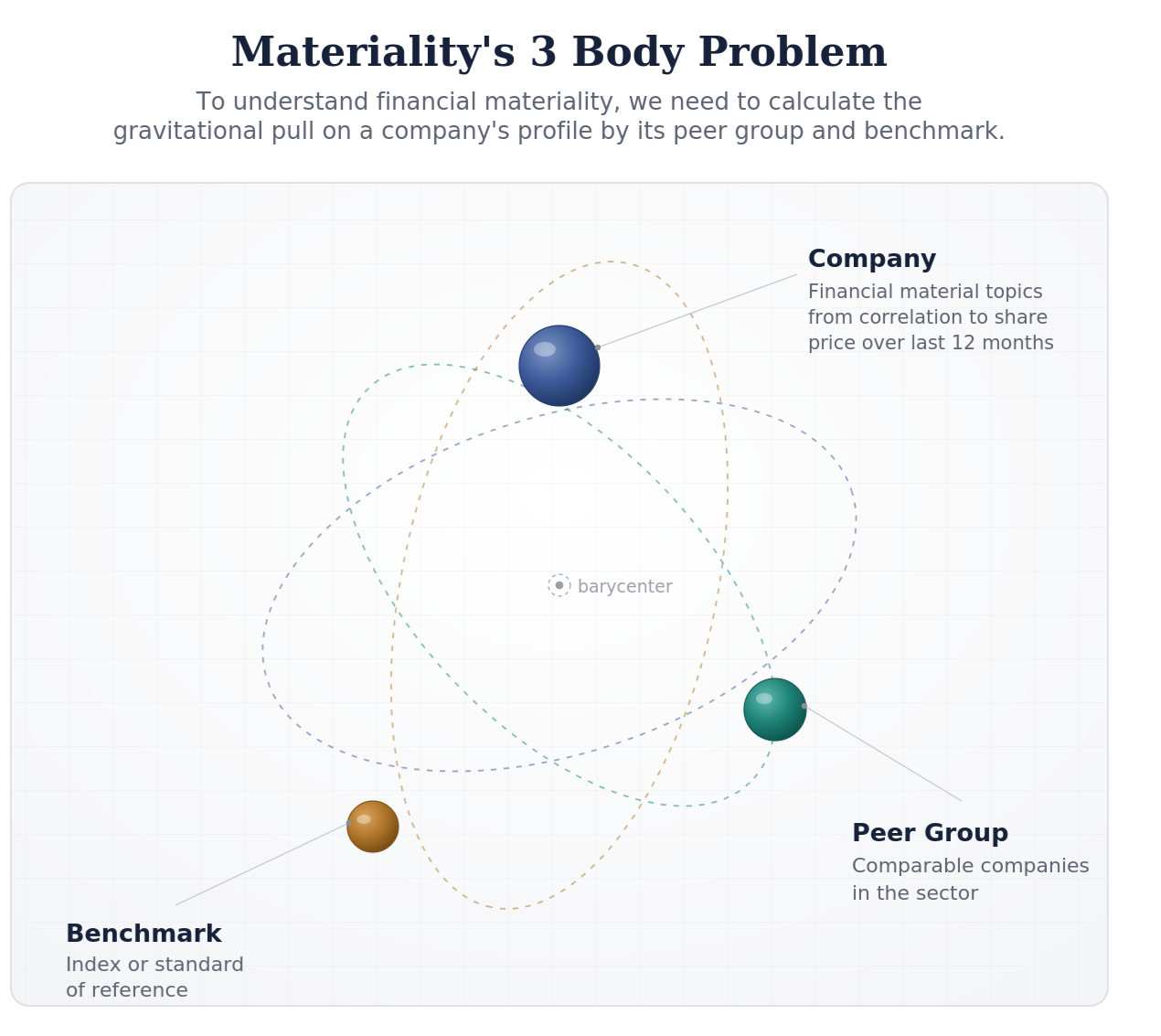
When preparing an assessment (ISSB or CSRD), the guidance is clear: compare the entity in question to a peer group and a benchmark to give context. This is correct and sensible. But it's remarkably hard to do objectively, in a data-driven methodology, with an auditable process. The reason is well-known in classical mechanics or astrophysics. It is called "The 3 body problem". It is the mathematical study of how three celestial objects (like stars or planets) interact purely through their gravitational pull. While a "two-body" system (like the Earth and Sun) has predictable orbits, adding a third body (like Earth's moon) creates a chaotic, unpredictable system with no general mathematical formula to solve it.
In our terms, the reporting company is the Earth, the peer group is Moon and the benchmark is the Sun. Using publicly-available data from traditional, trade and social media correlated to closing day share price, we can build a materiality profile of a company (Earth), aggregate several peer companies to build a peer group's profile (Moon), and aggregate all the companies in a benchmark to build a benchmark's profile (Sun). The three profiles act on each other in a chaotic, unpredictable way. To be clear, we have a reasonable answer one, two, three month into the future but, beyond that, there is no way to predict the where the Earth will be. So we struggle to answer the question: "What is the most material sustainability topic for the company?"
Translating research into a commercial product
Our vision is to develop the world’s first automated, auditable and transparent financial materiality assessment tool, thereby helping to establish the UK as a global leader in sustainable finance.
In our previous research project, we developed a novel two-stage algorithm for ranking financial materiality topics based on open-source data. Such a ranking can be used to help a company decide which drivers to report on in its required regulatory disclosure and decide on a broader ESG strategy (e.g. in media communication, or in terms of prioritizing resource allocation to mitigate a poor ranking, or in terms of improved communication to correct a misconception). To the best of our knowledge, our work is the first of its kind in the sustainability space on quantifying how the secondary market reacts specifically to ESG news items pertaining to various financial materiality drivers.
We are now translating this research into a commercial product. To start with, we are running short three proof-of-concept projects over the next few months using our algorithmic approach. We are answering three related wicked problems:
For auditors, how to provide assurance on a sustainability report in a timely and reasonably-priced way?
For institutional investors, how to quantify the level of conviction when optimising a portfolio?
For reporters, how to align what is material for the corporate with what is material in the supply chain?
While our research is conducted under Chatham House rules, we are pleased that each of the three projects has attracted market-leading global companies.
Hierarchical Machine Learning
A key step in moving from ‘lab prototype’ to real world application is to modify the machine learning model to cope with a larger universe of companies. For an automated pipeline, a grid search on all hyperparameters for each new stock or each week is infeasible. Instead, we are testing an extra layer of machine learning on top of the current ML engine to choose sector-appropriate hyperparameters for the two-stage algorithm. A network will be trained for hyperparameters using sentiment scores- stock price return datasets (along with added industry sector information) for a small ‘training set’ of companies as inputs and their manually tuned hyperparameters as outputs. Its performance will be validated on similar datasets of ‘testing set’ of companies. This will give a more robust ‘from stock ticker to driver rankings’ automated pipeline.
We suggest this is a better way of identifying what is material at sector level than the a priori approach championed by industry trade associations.
Transparent Methodology
In building out the standard for data-driven financial materiality for sustainability topics, we must avoid any black boxes. So we have committed to publishing a peer-reviewed academic paper as well as a white paper explaining our methodology and results. We will also be holding industry workshops in the Autumn. This is part of Maxwell Data’s commitment to building out trustworthy AI as the way to drive sustainable investing.