
What does ‘data-driven’ financial materiality actually look like?
This article is the third in a series exploring the role of trustworthy AI in mainstreaming sustainable investing.
Last month Maxwell Data held an industry workshop at Brunel University of London for expert stakeholders on data-driven financial materiality for sustainability reporting. There was a broad consensus that the current process isn’t fit for purpose. There was also a broad agreement that a data-driven approach is preferable.
Drawing on the debate at the workshop, this article sets out the problems with the current process. It uses a published example from Deloitte (2023) as an example of the status quo and draws a comparison with a generic version of a data-driven financial materiality assessment process. For transparency, we disclose the peer-reviewed research on this subject by Maxwell Data and Brunel, and a prototype being piloted with three global firms.
What is financial materiality?
IFRS S1 defines financial materiality as “information that is important enough that leaving it out, misstating it, or hiding it could influence the decisions of users of financial statements (mainly investors, lenders, and creditors).”
In other words, financial materiality is about a company telling its investors what drives value in the business. Different investors make different assessments of that value but everyone starts from the same set of numbers. In that way we have an efficient market that can accurately allocate capital according to the greatest expected returns.
The standard process
Deloitte has published a helpful explanation of its process for determining what is financially material. This is set out below as an example of a non-data-driven financial materiality process in order to compare and contrast with a data-driven approach. Other sustainability assurance providers operate a similar process.
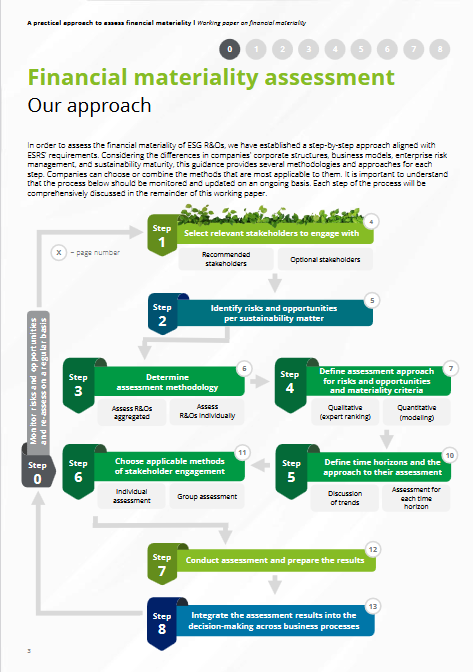
Source: Deloitte 2023. A practical approach to assess financial materiality. Working paper on CSRD double materiality.
There are nine steps in the Deloitte process.
Select relevant stakeholders to engage with. Who are these people? How do you select them? What happens if they don't respond? At best, you get a couple hundred responses of variable insight after months of chasing. A data-driven approach collects all the publicly-available conversation from engaged stakeholders who are knowledgeable on the ESG matters pertinent to the company, its peers and its industry on an ongoing basis.
Identify risks and opportunities per sustainability matter. To draw up a 'long list' of all the potential upside/downside risks associated with any sustainability issues that may be pertinent to the company, its peers and its industry. At best, this is a time-consuming desk exercise that contains many assumptions. A data-driven approach uses machine learning to tag hundreds of thousands of conversations against the ISSB taxonomy on a daily basis. The same is done for the peer group and the industry. The results can be drawn down on demand.
Determine assessment methodology. The company can decide whether to assess the financial materiality of sustainability matters at either an individual or aggregated level. At best, auditors, investors and regulators don't question the assessment methodology chosen. A data-driven approach assesses the ESG topics set out in the ISSSB taxonomy. A sentiment analysis quantifies the extent to which investors think the topic is a risk or opportunity.
Define assessment approach for risks and opportunities and materiality criteria. This is usually a qualitative exercise that relies on subjective judgment and expert opinion. At best, auditors, investors and regulators don't question the assessment approach chosen. A data-driven approach uses statistical methods to calculate the correlation between a company's ESG topics and the movement in its share price. The same correlation is run on peers and industry to quantify materiality.
Define time horizons and the approach to their assessment. The topics should be assessed against a short-, medium- and long-term time horizon. This assessment uses qualitative factors and scenario analysis to identify whether an issue will affect cash flows, access to finance, or cost of capital over a given time period. At best, auditors, investors and regulators don't question the assessment approach chosen. A data-driven approach uses share price movement as an impartial, objective dependent variable. The approach calculates how much impact on share price movement can be attributed to each ESG topic. This analysis can be performed (and backtested) on short- and medium-term time horizons. The data provides the quantitative underpinnings for a long-term time horizon.
Choose applicable methods of stakeholder engagement. There is no consensus methodology on this step. In contrast, a data-driven approach has already included the relevant stakeholders when collecting all the publicly-available conversation on the ESG matters pertinent to the company, its peers and its industry.
Conduct assessment and prepare the results. There is no consensus methodology on this step. In contrast, a data-driven approach is particularly applicable to standard LLMs. With standard prompts, LLMs are useful in generating nuanced graphical representations of the upside/downside risks associated with any sustainability issues calculated as financially material to the company, its peers and its industry. The datasets can also be made available to investors for their own analysis.
Integrate the assessment results into the decision-making across business processes. There is no consensus methodology on this step, particularly because the insights are already at least nine months out-of-date by time of publication. In contrast, a daily data-driven approach can be integrated into the daily decision-making process of the organization, business planning, budgeting, management, remuneration and the overall enterprise risk management (ERM) process.
Monitor risks and opportunities and reassess on a regular basis. Regularly repeating the previous eight steps isn't feasible for any company. If nothing else, it leads to stakeholder disengagement. In contrast, a data-driven approach is a similar to api-driven processes already used by Finance, Marketing, HR and Sales functions.
A data-driven process
The standard process is unwieldy, slow, expensive and subjective. In contrast, a data-driven process uses standard digital technologies to streamline, accelerate, cut costs and drive objectivity. A generic data-driven approach to financial materiality is set out below.
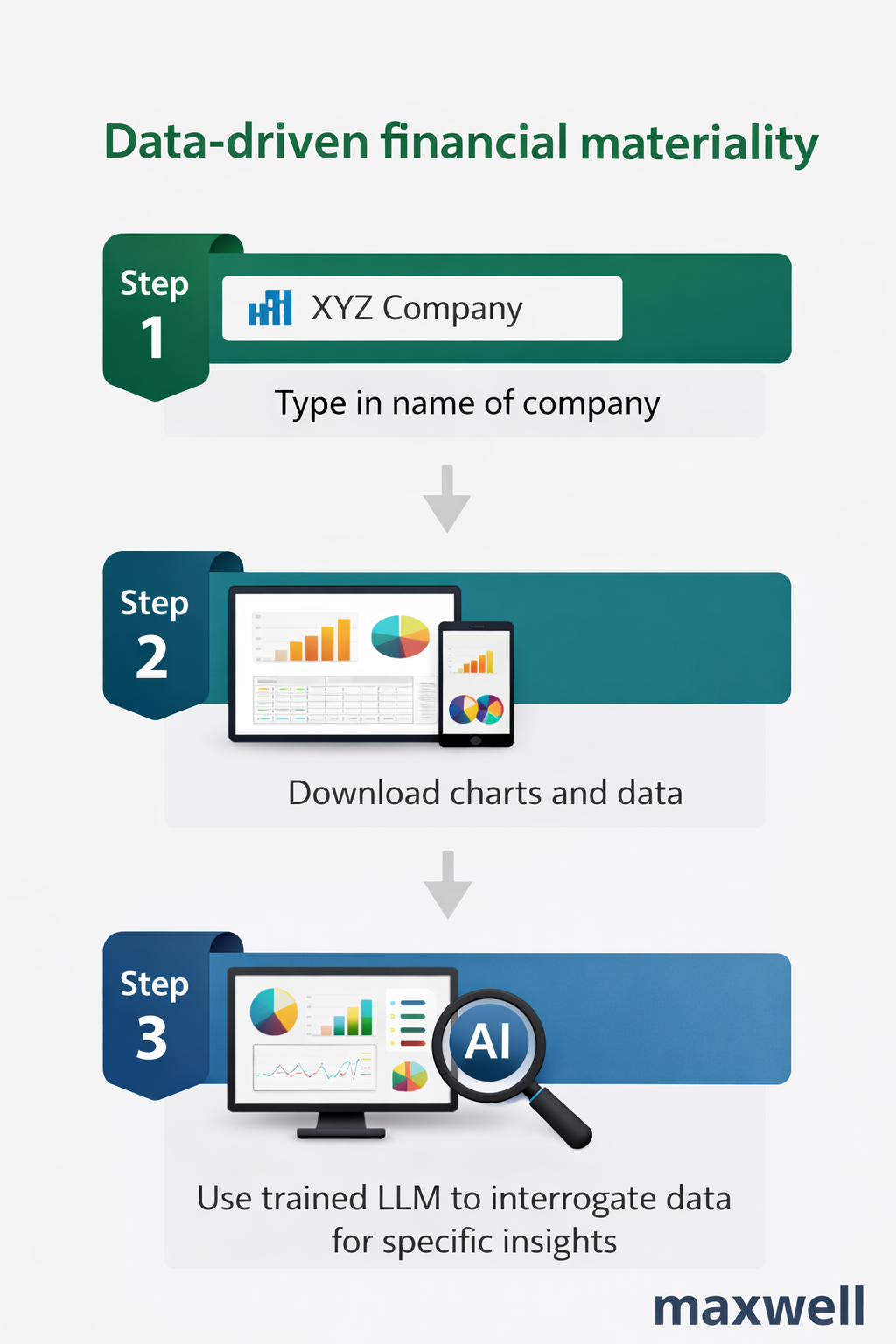
Source: Maxwell Data 2026
There are three steps in the generic data-driven process.
Type in the name of company. The database contains the names of the largest 1,300 public companies in UK, EU and USA. All publicly-available conversations from relevant stakeholders have been collected, tagged and correlated to daily share price movement. If the company name isn't already in the database it can be added, if there is enough conversation to ensure the results are robust. If not, the peer group and industry can be used as proxies. This also holds for private, non-listed companies.
Download charts and data. Because a data-driven process uses publicly-available data (open sourced intelligence and share price data), the manual analyses of the Deloitte process have already been conducted. Specifically, steps 1 to 5 have been automated. Step 6 is no longer relevant. The analyzed data on the entity, its peer group and industry can be downloaded directly from the IU or accessed via api. This delivers an audit trail.
Use trained LLM to interrogate data for specific insights. There is no consensus on step 7 so reporters have the opportunity to save time and resources with standard LLM prompts to generate nuanced graphical representations of the upside/downside risks associated with any sustainability issues calculated as financially material to the company, its peers and its industry. Similarly there is no consensus on step 8, perhaps because widespread use of LLMs is more recent than the Deloitte publication. There are now multiple opportunities to integrate assessment results into the decision-making across business processes. And, with an automated data pipeline available through apis, monitoring risks and opportunities and reassess on a regular basis is much more straightforward.
The AI behind Maxwell's data-driven approach to financial materiality of sustainability matters is published here. The recent Brunel workshop concluded that there are three use cases worth exploring with this data-driven approach: in assurance, in portfolio risk management, and in global supply chains. We will set out this research agenda in the next article in the series, together with an invitation to join the research programme.