
How to use AI to conduct a financial materiality assessment under IFRS S1
This article is the sixth in a series exploring the role of trustworthy AI in mainstreaming sustainable investing.
This article addresses an increasingly common use case. It is estimated that over 100,000 companies will report under IFRS S1. The number of jurisdictions globally with ISSB-related sustainability reporting frameworks and standards is 45 in Q2 2026, and continues to grow. The interoperability between CSRD in Europe and ISSB will add thousands more of the world's largest companies to those reporting using the IFRS SI standard.
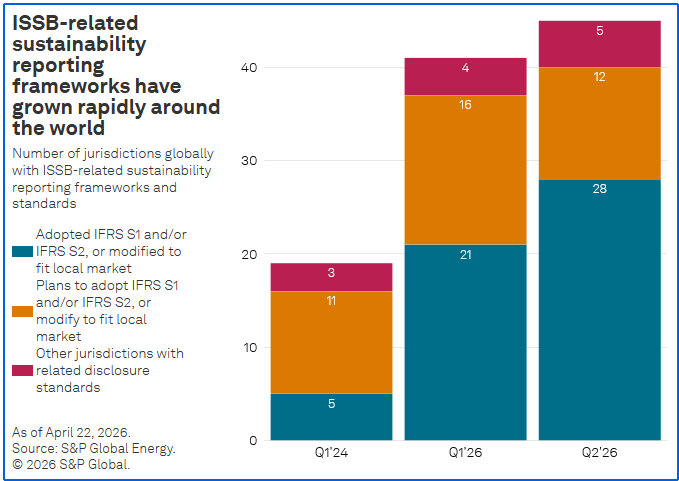
Source: S&P Global Energy, April 2026
At the same time, corporate reporters, institutional investors and assurance providers are all experimenting with AI-powered use cases to improve the sustainable investing experience. Identified use cases include data ingestion and extraction, emissions mapping, compliance and validation, and predictive risk and forecasting. Given the fundamental nature of materiality to sustainability and its receptiveness to a data-driven approach, using AI to conduct a financial materiality assessment under IFRS S1 is an obvious use case.
What is materiality?
The definition of materiality is well-known and broadly accepted. Information is material "if omitting, misstating or obscuring that information could reasonably be expected to influence decisions that primary users of general purpose financial reports make." (IFRS S1, paragraph 18).
Primary users are defined as existing and potential investors, lenders and other creditors. So IFRS S1 is solely concerned with financial materiality and not impact materiality. By contrast, the European CSRD regulation is concerned with both financial and impact materiality.
Materiality is a foundational concept in IFRS S1. If your materiality determination is incorrect, it dominoes across the whole disclosure - governance narrative, strategy, metrics, targets. So getting this right at the start is imperative.
Who is responsible for determining materiality?
The corporate reporter is responsible. While the SASB materiality matrix has been used as a materiality template, this is no longer sufficient and will fail audit. In March 2026, the International Sustainability Standards Board (ISSB) published 'Proposed Amendments to the SASB Standards and IFRS S2 Industry-based Guidance'. Comments closed at the end of July 2026. This clarified who is responsible for determining which topics are material and so need to be reported:
“materiality is an entity-specific assessment and the responsibility for determining what matters to provide information about and for assessing what disclosures constitute material information rests with the reporting entity.”
So a materiality determination must be entity-specific and cannot be inferred from generic guidance. Reporters need to do the hard work and get it right. So what is the most efficient process?
Common approach
There is a common, four-step process to make a materiality assessment. This is set out in 'IFRS Practice Statement 2: Making Materiality Judgements (Practice Statement)'. While the Practice Statement is non-mandatory, deviation from the approach would need to be explained at audit. The four steps are:
1. Identify
Identify information that has the potential to be material
IFRS S1 requires entities to use "all reasonable and supportable information that is available to the entity at the reporting date without undue cost or effort." (IFRS S1, paragraph B6). So you need to build a long list of sustainability-related risks and opportunities (SROs) relevant to your business.
There is no prescribed way of doing this but this often involving your risk management team, your sector analysts, and your investor relations function if they exist. It assumes a level of data gathering, time- and resource-capacity, and focus that may not exist. It requires project management, documentation, liaison with assurers. And it needs to be comprehensive, up-to-date, and within budget.
2. Assess
Assess whether the information identified in step 1 is, in fact, material
For each risk/opportunity identified, you need to assess whether omitting or misstating information about it could reasonably influence the decisions of primary users. IFRS S1 states that this judgement requires considering both quantitative and qualitative factors (paragraph B21). You need to consider the magnitude, likelihood, nature, time horizon of each risk/opportunity and be able to defend these judgements.
Again, there is no prescribed way of doing this so this exercise can easily consume time, resources, and focus in a business. And, because the output criteria of this step is vague, it is hard to know when this step is complete. 'The output of Step 2 involves the identification of information that, if not recognized or otherwise misstated, could reasonably be expected to influence primary users' decisions' (Practice Statement paragraph 43).
3. Organise
Organise the information within the draft financial statement in a way that communicates the information clearly and concisely to primary users
This step is more conceptually straightforward but often takes the most amount of time. Using the metrics and protocols listed against each of the topics, make your disclosure.
While the guidance at this step is well-tested and fairly clear, sustainability professionals complain that this step involves hours of chasing colleagues and suppliers for information which is poorly formatted, incomplete and out-of-date.
4. Review
Review the draft financial statements to determine whether all material information has been identified and materiality considered from a wide perspective and in aggregate, on the basis of the complete set of financial statements
This step often attracts the most scrutiny from auditors and assurance providers. IFRS S1 paragraph 74 requires entities to explain why each material topic was included and why other topics were considered non material. This is both laborious and inconclusive, trying to prove a negative is frustrating.
Where and How to use AI
Staying firmly within the four-step process set out in the IFRS Practice Statement, several AI-enabled options are available. The goal is to deliver the same, or better, outcomes while using fewer resources, time, and effort. This list is not exhaustive and correct as of August 2026.
1. Identify
Identify information that has the potential to be material
Use an open-sourced intelligence approach that gathers all the conversation in the market about your entity relevant to sustainability topics. Use the SASB taxonomy to filter the conversation. Use a machine reading approach to understand which topics are material to your business model, including supply chain, over the reporting period and in comparison to the previous reporting period. Use machine learning to analyze the trends in the data as materiality is dynamic so a large event at the beginning of the reporting period may not, in fact, by judged material in the context of the whole period. Use sentiment analysis to accurately quantify risks and opportunities.
Where to start. From your current AI assistant (Claude, OpenAI, Gemini, Copilot, etc), use Maxwell Data's MCP connector to identify information that has the potential to be material about your entity. Share the methodology with your assurance provider.
2. Assess
Assess whether the information identified in step 1 is, in fact, material
With a curated open-sourced intelligence approach, it is possible to rank which sustainability topics are most correlated to share price. Taking share price as a Dependent Variable is not perfect but it offers a clear metric of investor action. Using algorithmic statistical modeling, surface which topics and most material and the extent to which they are risks and opportunities. This step will attract scrutiny at audit so make sure the methodology is publicly-available and not proprietary.
Where to start. From your current AI assistant, use Maxwell Data's MCP connector to assess whether the information identified in step 1 is, in fact, material. Share the assessment with your assurance provider.
3. Organise
Organise the information within the draft financial statement in a way that communicates the information clearly and concisely to primary users
You may well already have an enterprise data management system. Use this to curate the data required to report against each of the metrics linked to your material topics. Many reporters use Excel, some are now experimenting with generative AI to draft assurance-ready content.
Where to start. Use sustainability data management platforms like Workiva, Watershed , SWEEP, Greenly to collect, organise and be ready for audit. Use AI-native tools like Ella | AI ESG Agent, Terralyn to generate regulatory-appropriate text to be inserted in to the draft financial statements.
4. Review
Review the draft financial statements to determine whether all material information has been identified and materiality considered from a wide perspective and in aggregate, on the basis of the complete set of financial statements
Being able to justify 'materiality considered from a wide perspective and in aggregate' is a particularly hard problem to solve. More recent guidance from EFRAG on double materiality under CSRD takes the pragmatic approach that a wide perspective is a comparison between the reporting entity, its peer group and its benchmark (2026 Revised ESRS, AR 14)
Where to start. From your current AI assistant, use Maxwell Data's MCP connector to review materiality across an entity, its peer group and its benchmark, solving what is called materiality's three body problem. Share the review with your assurance provider.
Conclusion
Maxwell Data and the Department of Mathematics at Brunel University of London are currently working with corporate reporters, institutional investors and assurance providers on proof-of-concepts of the data-driven approach to financial materiality. We will present the findings at an industry workshop at UCL Centre for Sustainable Business on 18th September. If there is consensus, we will work with stakeholders to roll out a data-driven approach to financial materiality for sustainability matters as an industry standard ahead of reporting season in Q1 2027.