

Sustainability Signal you can query
Solve your Three body problem.
Ask for a free report
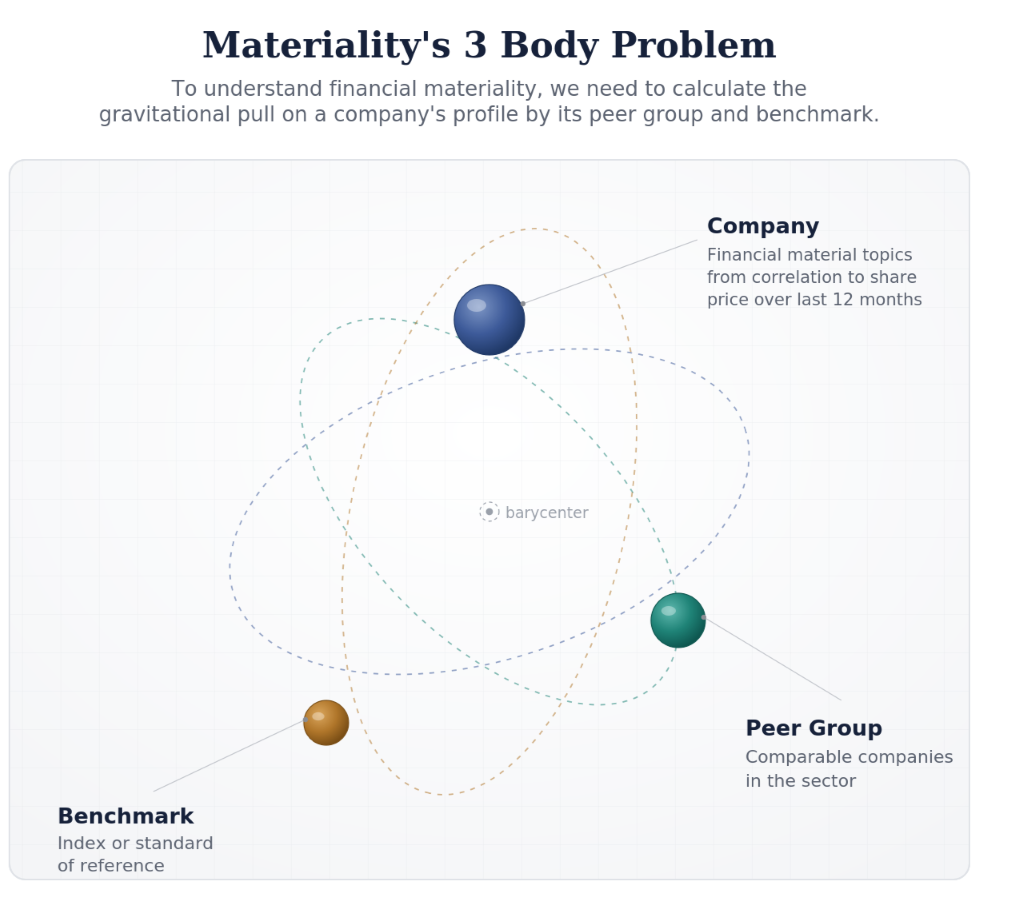
Sustainability starts with materiality. Compare an entity to its peer group and benchmark to give context. But comparing three bodies is remarkably hard to do objectively and consistently, with an auditable process. We have solved this wicked problem. Click the button below to ask for a free report.
Sustainability signal for reporters, investors, assurers
Ask_Maxwell.
A queryable database of the most material sustainability topics for 1,200 securities in UK, EU, and US. Based on the correlation between all publicly available data and daily share price, not annual reports from last year. Updated weekly.
Access using your current favourite LLM, like Claude, ChatGPT, Gemini, CoPilot. Find what you are looking for, understand the results in context using a peer group and an industry benchmark (as required by ISSB/CSRD), query using natural language prompts, build your visualisations, export as you wish.
A real world example of trustworthy AI to enable users to make hard decisions.
Read the underlying academic research paper here:
Majid Jangani, Paresh Date and Andrew Tucker. February 2026. A New Approach to Identifying Key Financial Materiality Drivers from Sentiment Data
forthcoming on ‘Handbook on AltData for Finance’ 2nd edition (Chapman and Hall Press)
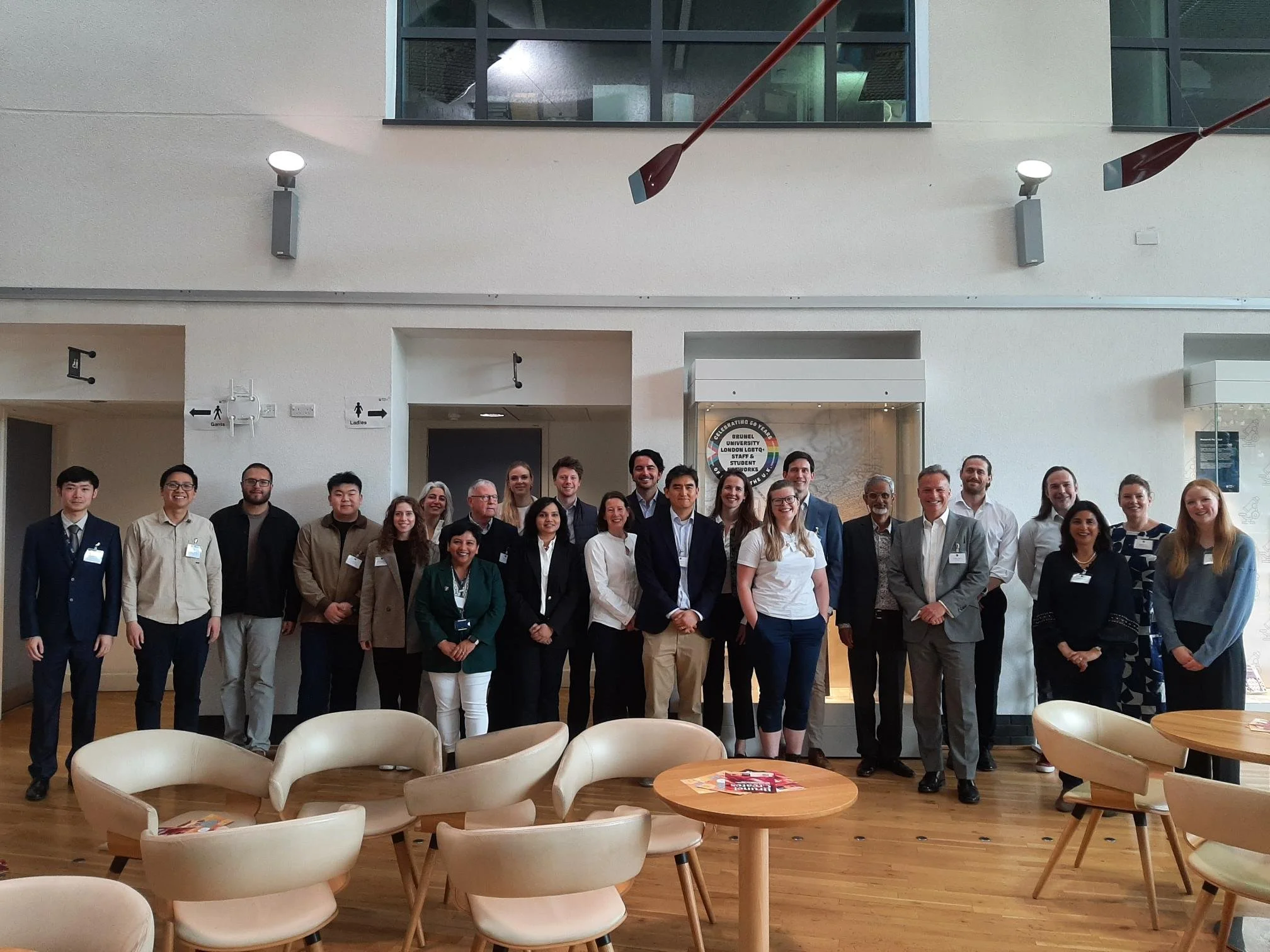
Ask_Maxwell industry workshop May 2026
Brunel, University of London. Data-driven financial materiality
01
A group of industry experts from across corporate reporters, institutional investors, assurance providers and accounting academics convened to address the challenges of financial materiality. We agreed a data-driven approach can solve many of the pain points identified. We set out to test this approach across three use cases in Summer 2026, and to reconvene at UCL School of Management in September 2026 to review the results.
From description to conviction.
How investors can use dynamic sustainability risks/opportunities metrics to better inform their quarterly portfolio reviews.
03
Finding signal in the noise.
How corporate reporters can get an objective understanding of what is material for them, compared to their peers and benchmarks.
Data-driven assurance.
02
How assurers can ‘see the whole board’ in a timely and cost-effective way to provide repeatable, consistent results.
Sustainability signal for retail investors
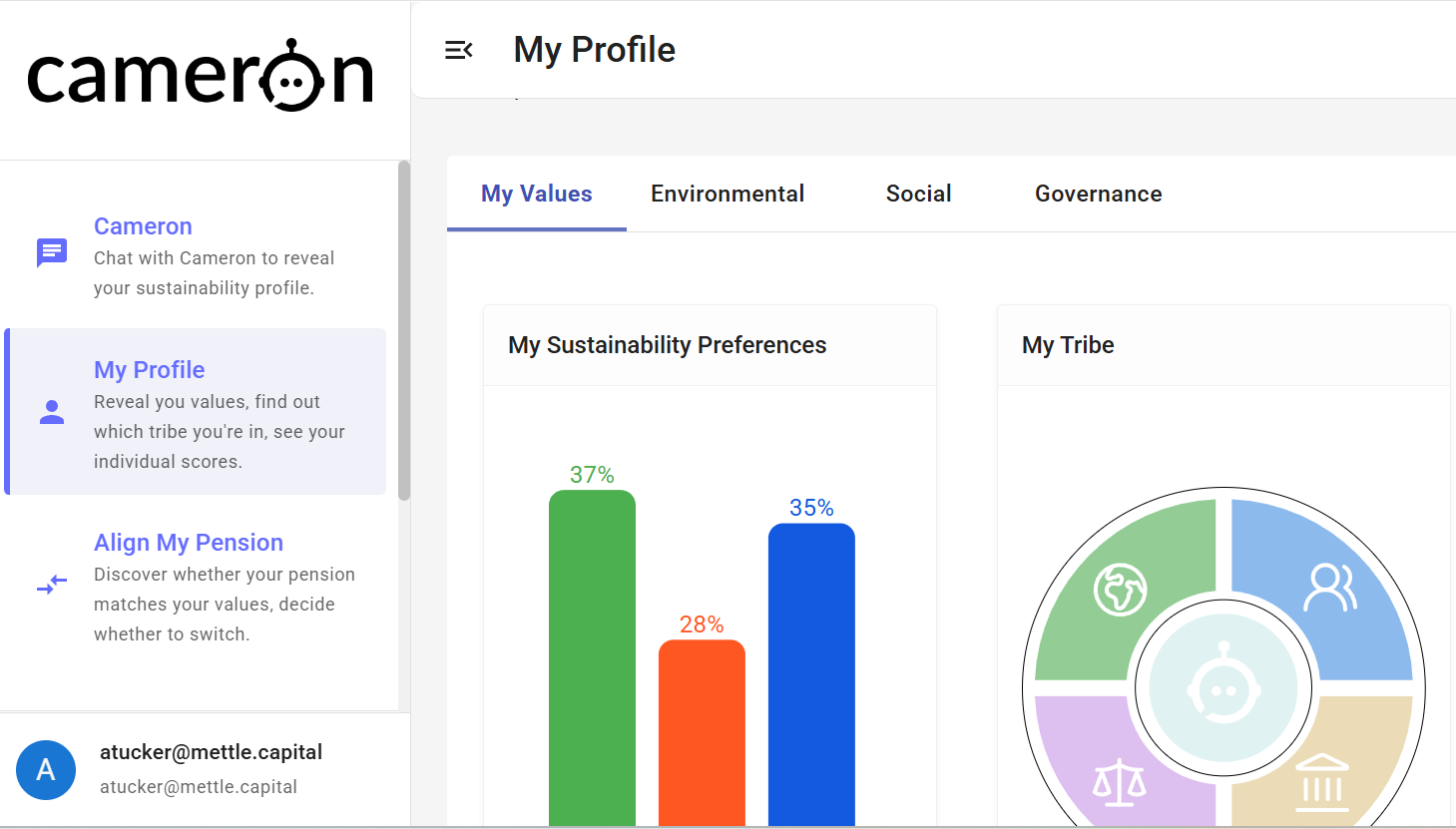
Ask_Cameron.
A conversational AI to discover your sustainable investing preferences, build your profile, match to appropriate funds. Enables sustainable investors to build the world they want to see.
A real world example of trustworthy AI to enable users to make hard decisions.
Read the underlying academic research paper here:
Benjamin Winter, Federico Castagna, Ross Baker and Andrew Tucker. March 2026. Cameron: An Interpretable Conversational AI Framework for Multi-Dimensional Sustainability Preference Assessment
forthcoming on ‘AI & Society’ (Springer)
Spotlight on Cameron
We presented Cameron at Innovate UK’s National Showcase on Next Generation Professional & Financial Services in November 2025
Meet the Team
-
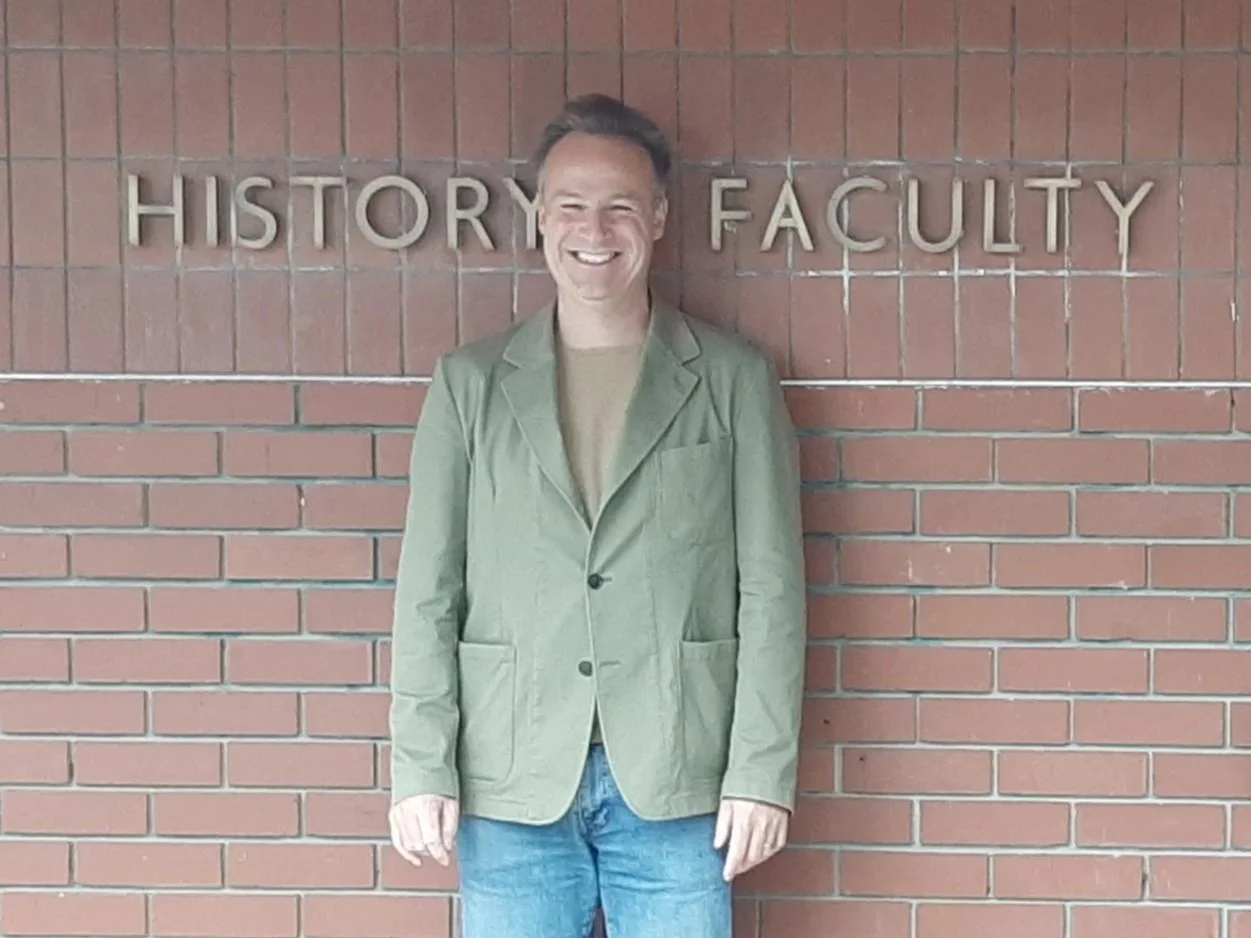
Andrew Tucker PhD
Co-founder, Product
Originally an academic specialising in the modeling of intangible assets like trust in organisations. For the last 14 years, Andrew has built fintechs solving real world business problems using evolving AI methodologies. Andrew holds a PhD (distinction) from Georgetown University in Political Theory. -

Chris Bowles
Co-founder, Engineering
Started out as a Theoretical Astrophysicist before focusing on software engineering and database development. Chris has 25 year’s experience, focused on data-driven systems and cloud technologies. Chris is a certified scrum master and a Welsh international hockey player. -

Professor Paresh Date
Academic Advisor
Professor and joint Head of Department, Department of Mathematics, Brunel University of London. With background in engineering, his expertise sits at the intersection of nonlinear state estimation (filtering), financial mathematics, machine learning, and stochastic control.
-

Ben Winter PhD
Machine Learning Engineer
The lead researcher on the conversational AI component of Maxwell’s Ask_Cameron product. Ben focuses on developing scalable AI solutions that bridge the gap between cutting-edge research and practical applications. -
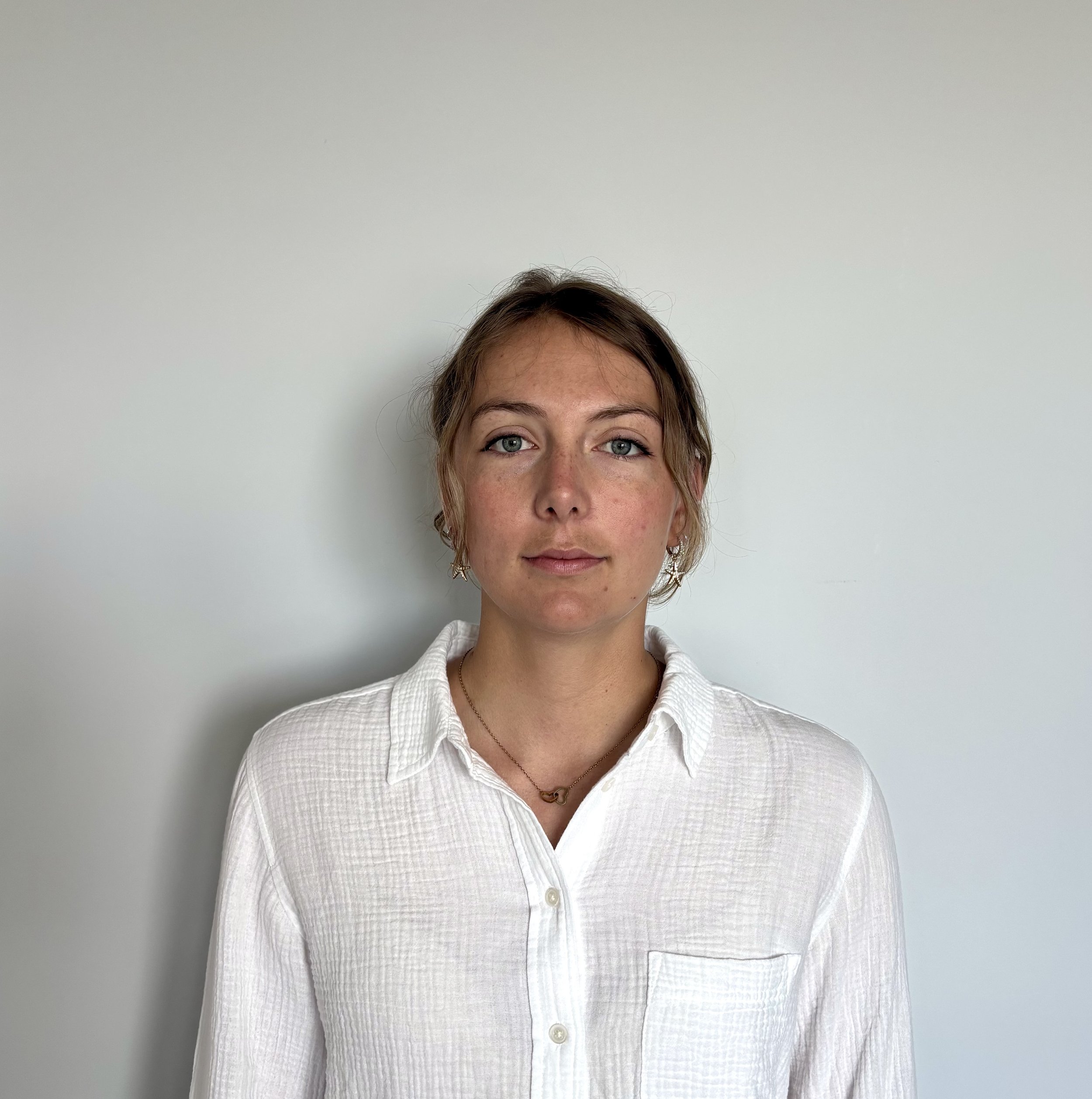
Sophie Chowgule
UKFIN+ Researcher
Sophie is currently an MSc student in Statistics with Data Analytics at Brunel University London. Her academic research is focused on developing a novel pipeline to model arteries, while in her career she's aiming to become a data scientist who solves real-world problems with meaningful, data-driven solutions. Outside of her studies, Sophie plays Ultimate Frisbee at a high level, representing GB at the U-24 World Championships last year.
-

Pradip Pokhrel
UKFIN+ Researcher
Pradip is a postgraduate student pursuing an MSc in Financial Mathematics at Brunel University London, specializing in Scientific Machine Learning (SciML), operator learning, and reduced-order modelling. Alongside his academic research developing stability-preserved neural operators for turbulent fluid dynamics, his focus is on applying data-driven frameworks and advanced analytical techniques to real-world datasets.

Frequently Asked Questions
-
We have built two products focused where they can drive sustainable investing the most.
Ask_Maxwell is a queryable database of the most material sustainability topics for 1,500 securities in UK, EU, and US. Connect using your current favourite LLM, like Claude, ChatGPT, CoPilot. Find what you are looking for, query using natural language prompts, build your visualisation, export as you wish.
Ask_Cameron is Uswitch for sustainable pensions and funds. Talk with Cameron to reveal your sustainable investing preferences and let Cameron match your values to the most appropriate funds in the market.
-
You can query Maxwell’s database directly from your current AI assistant, like Claude, OpenAI, CoPilot or Mistral.
You simply use Maxwell’s MCP (Model Context Protocol). This is allows AI models (like LLMs) to connect securely to external data sources. An MCP has been well-described as a "USB-C port for AI". So you don’t have to build an interface, you can just write a natural language query. Or even use the queries Maxwell has already written for users.
-
This refers to artificial intelligence systems designed to be safe, reliable, transparent and fair in order to respect ethical principles and legal regulations and so build users’ trust.
More than that, it is also an approach to interacting with users in a way that they can find the technology trustworthy in the same way as other real world systems, like government, academia and policing.
Building on our original academic research and real world experience of trust systems, we have designed Ask_Maxwell and Ask_Cameron to build trust in the same way as humans build trust. That is, which types of trust are most relevant in the situation, how much trust is enough for the user to make a decision, and how to reinforce and refresh trust over time.
-
An investment approach that generates long-term financial returns while actively supporting positive environmental, social and goverance (ESG) outcomes. It involves selecting companies with strong sustainability practices - such as low carbon emissions, good labour standards - to reduce risk and create a better world.
-
When preparing an assessment (ISSB, CSRD), guidance is clear: compare the entity in question to a peer group and a benchmark to give context. This is correct and sensible. But it's remarkably hard to do objectively, in a data-driven methodology, with an auditable process.
The reason is well-known in classical mechanics or astrophysics. It is called "The three body problem". It is the mathematical study of how three celestial objects (like stars or planets) interact purely through their gravitational pull. While a "two-body" system (like the Earth and moon) has predictable orbits, adding a third body (like the Sun) creates a chaotic, unpredictable system with no general mathematical formula to solve it.
In our terms, the reporting company is the Earth, the peer group is Moon and the benchmark is the Sun. Using publicly-available data from traditional, trade and social media correlated to closing day share price, we can build a materiality profile of a company (Earth), aggregate several peer companies to build a peer group's profile (Moon), and aggregate all the companies in a benchmark to build a benchmark's profile (Sun). The three profiles act on each other in a chaotic, unpredictable way. To be clear, we have a reasonable answer one, two, three month into the future but, beyond that, there is no way to predict the where the Earth will be. So we struggle to fully answer the question: "What is the most material sustainability topic for the company?"
With a grant from UKFin+ Network, Maxwell Data and Brunel University of London are working on this "wicked problem" over the summer through a number of proof-of-concepts. We will be convening an industry workshop in September at UCL Centre for Sustainable Business to review a potential industry standard solution. -
We believe in trustworthy AI so we make our methodologies publicly available.
We believe that the best way to build a more sustainable world is to surface the metrics that prove real world performance.
We believe that generative AI, used appropriately, is an ideal way for many users to interrogate and understand the data according to the questions they want answered.
In that way, capital will be allocated most efficiently to the most sustainable companies.
-
Getting started is simple. Use our contact to set up an initial conversation. We will walk you through the next steps with Ask_Maxwell or Ask_Cameron and answer any questions along the way.
-
You can reach us anytime via our contact page or email. We aim to respond quickly—usually within one business day.
Contact Us
To request a free three-body materiality report, please include:
the name of the target company
the names of the target’s peer group (ideally more than 5 and less than 10)
the name of the target’s benchmark/index (for example FTSE100, S&P500, CAC40)
We will email you a free report within 24 hours.